Open Access | Mini review
This work is licensed under a Creative Commons Attribution-ShareAlike 4.0 International License.
Countering oxysterol-driven neurodegeneration: diosgenin as a privileged steroidal scaffold for novel Alzheimer’s disease therapeutics
* Corresponding author: Sarvesh Sabarathinam
Mailing address: Helix Research Lab, Saveetha Medical College
and Hospital, Saveetha Institute of Medical and Technical Sciences (SIMATS), Saveetha University, 602105 Chennai, Tamil
Nadu, India.
Email: sarveshtvg@gmail.com
This article belongs to the Special Issue: New Treatment for Alzheimer’s Disease
Received: 28 May 2026 / Revised: 05 June 2026 / Accepted: 23 June 2026 / Published: 30 June 2026
DOI: 10.31491/APT.2026.06.226
Abstract
Alzheimer’s disease (AD) is a multifactorial neurodegenerative disorder characterized by amyloid-β accumulation, tau pathology, oxidative stress, neuroinflammation, and lipid dysregulation. The limited success of single-target therapeutics has shifted attention toward multi-target phytotherapeutics with pleiotropic neuroprotective properties. Diosgenin, a steroidal sapogenin structurally related to cholesterol-derived oxysterols, has emerged as a promising candidate owing to its antioxidant, anti-inflammatory, and neurorestorative activities. This mini-review highlights diosgenin as a structural antagonist to 7-ketocholesterol (7-KC), emphasizing its ability to modulate oxidative stress, amyloidogenesis, neuronal survival, and membrane stability. Additionally, translational strategies including semi-synthetic modification and nanocarrier-mediated brain delivery are discussed as future therapeutic avenues for AD management.
Keywords
Alzheimer’s disease, diosgenin, 7-ketocholesterol, neuroprotection, steroidal sapogenins
Introduction
Alzheimer’s disease (AD) is a progressive neurodegenerative disorder characterized by spatiotemporally ordered neuronal loss that initiates in the entorhinal cortex (EC), the brain region exhibiting the earliest histological alterations, including neurofibrillary tangle formation and layer 2 neuronal cell death. The hippocampus, amygdala, and para-hippocampal gyrus, all crucial regions for episodic memory consolidation, are then affected by degeneration. Atrophy spreads to the frontal cortex, temporal lobe, and related limbic areas as the disease progresses, leading to increasing impairments in language, executive function, and overall cognition. The temporal sequence of cognitive decline is reflected in this regional progression: memory impairment comes before language problems, which come before executive dysfunction [1-4]. The brain’s neurons are essential to all human functions, including thinking, speaking, and walking. Since the neurons in these regions of the brain are the first to be damaged, memory, language, and thinking (cognitive) problems are frequently the earliest indications of AD. An estimated 7.2 million Americans aged 65 years and older are currently living with Alzheimer’s dementia, with projections reaching 13.8 million by 2060 barring the development of medical breakthroughs to prevent or cure Alzheimer’s disease [5]. If medical advancements are not made to prevent or treat AD, this figure could increase to 13.8 million by 2060. In 2022, 120,122 AD deaths were listed on official death certificates. AD has been the seventh most common cause of death in the US since 2020, when COVID-19 rose to the top 10 [5]. A wide range of pathological pathways, such as neurotransmitter signaling, inflammation and immune processes, Aβ and tau biology, synaptic dysfunction, metabolism and bioenergetics, oxidative stress, proteostasis, vascular pathology, APOE/lipid pathways, the gut–brain axis, circadian regulation, epigenetic mechanisms, neuronal loss, and neurogenesis, is involved in current AD drug development. The emerging understanding that AD is a complex condition needing pathway-integrated therapy techniques is reflected in the development of a smaller group of candidates as multi-target medicines [6-8]. Because AD is a multifaceted illness involving intricately linked pathways that cannot be stopped by blocking a single protein, single-target Alzheimer’s medications (mostly anti-amyloid or anti-tau) have mainly failed. Thirty-five percent of AD medications under development are repurposed compounds [9]. By simultaneously addressing oxidative stress, neuroinflammation, cholinergic deficiencies, and protein aggregation, multi-target phytotherapeutics offer a systemic approach. Compared to narrow monotherapies, this multi-pathway modulation more successfully restores homeostatic balance. Numerous substances originating from plants have the potential to treat AD. They function by focusing on important disease-related enzymes, such as acetylcholinesterase (AChE), butyrylcholinesterase (BuChE), β-secretase, γ-secretase, and monoamine oxidases (MAOs). Clinical trials are currently testing a number of these natural compounds in an effort to create novel medications [10, 11]. The cholesterol-derived oxysterol 7-ketocholesterol (7-KC) has become a prominent mediator of oxidative stress, neuroinflammation, and neuronal damage in AD brain tissue, and recent clinical and experimental evidence indicates that lipid peroxidation and dysregulation of cholesterol metabolism contribute to AD pathogenesis [12-15]. According to new research, membrane-associated 7-KC can increase amyloidogenic amyloid precursor protein (APP) processing, change lipid raft architecture in neurons and astrocytes, and intensify cell death pathways such as ferroptosis and reduced autophagic flux. Therefore, targeting 7-KC with small compounds that lessen its membrane-associated toxicity may offer a possible treatment approach for Alzheimer’s disease [16].
Diosgenin as a structural counterpart to 7-KC
Diosgenin was chosen because of its structural similarity to oxysterols generated from cholesterol, which share the same tetracyclic steroidal backbone but have essentially different biological characteristics. Diosgenin exhibits strong antioxidant, anti-inflammatory, neurogenic, and membrane-stabilizing properties in contrast to 7-KC, a significant non-enzymatic oxidation product of cholesterol that aggravates neurotoxicity through mitochondrial dysfunction, lipid peroxidation, reactive oxygen species (ROS) generation, ferroptosis, and neuroinflammation via TLR4 activation [16]. While avoiding the cytotoxic membrane permeability changes and oxidative stress induction typical of 7-KC, its steroidal sapogenin architecture permits biophysical interactions with lipid-rich neuronal membranes, as demonstrated by X-ray diffraction and differential scanning calorimetry studies demonstrating concentration-dependent modulation of phospholipid bilayer structural perturbation and phase transition cooperativity. Additionally, diosgenin has been shown to have strong neuroprotective effects in experimental models of Alzheimer’s disease. Diosgenin is an appealing phytochemical scaffold for the simultaneous targeting of several pathogenic pathways in AD because of these complex processes, which include antioxidant, anti-inflammatory, anti-apoptotic, and neuro-regenerative qualities [17-20]. Steroidal compounds have long been at the forefront of drug discovery because of their rigid frameworks, membrane permeability, and receptor-binding versatility. Among them, diosgenin, a naturally occurring steroidal sapogenin [21, 22],
has consistently attracted attention for its bioactivity across cancer, metabolic, and inflammatory diseases. In contrast, 7-KC, a pro-oxidant oxysterol, contributes to atherosclerosis, AD, and retinal degeneration by driving oxidative stress, mitochondrial dysfunction, and cell death [23, 24].
This review highlights diosgenin’s unique potential as a structural antagonist to 7-KC, positioning it as a scaffold for therapeutic innovation in
phytotherapy-driven drug design.
Diosgenin (C27H42O3; molecular weight 414.62 g/mol) is a rigid, highly lipophilic steroidal sapogenin characterized by a high fraction of sp3-hybridized carbon (0.93), zero rotatable bonds, low polarity. It has a topological polar surface area (TPSA) of 38.69 Å2, and limited hydrogen-bonding capacity. Collectively, these physicochemical features favor membrane association and support its use as a structurally constrained scaffold in steroid-based drug design. Medicinal chemists recognize that subtle structural variations in steroidal frameworks can profoundly influence biological outcomes. Nobel laureate James Black famously remarked that “beginning with an old drug is the most fruitful basis for the discovery of a new drug,” a principle equally applicable to natural product scaffolds. Diosgenin exemplifies this philosophy: while sharing the cyclopentanoperhydrophenanthrene nucleus with oxysterols, it diverges in key substituents that confer redox stability and non-toxic pharmacodynamics [25]. A comparison underscores these contrasts. Diosgenin is a spirostane steroidal sapogenin, distinguished by a rigid spiroketal substituent at C17, whereas 7-KC is a cholestane oxysterol with a ketone at C7. Both share a conserved 3β-hydroxy group and Δ5 unsaturation, but their functional divergence is profound: diosgenin acts as an antioxidant and non-toxic sterol, while 7-KC is pro-oxidant and pro-apoptotic. This structural
antagonism provides a rationale for considering diosgenin as a counter-molecule to pathological oxysterols [26, 27]. Several drug-like features of diosgenin reinforce this notion. The spiroketal moiety stabilizes the D-ring and resists oxidative degradation, reducing susceptibility to enzymatic oxidation. Unlike 7-KC, which bears an electrophilic center capable of initiating harmful thiol reactions, diosgenin is chemically inert in this respect, thereby offering a safer
scaffold for drug derivatization. Furthermore, the preserved 3β-hydroxy group facilitates interactions with sterol-sensing proteins and nuclear receptors such as Liver X Receptor (LXR) and Farnesoid X Receptor (FXR), enabling functional mimicry of oxysterols without incurring cytotoxic liabilities. Its lipophilicity (logP ~4.9) supports membrane integration and oral bioavailability, further enhancing its translational potential [28]. It has long been known in medicinal chemistry that minute structural alterations in steroidal scaffolds can result in significant variations in biological activity. In this context, diosgenin provides an instructive contrast to 7-KC: both retain a steroidal nucleus with a 3β-hydroxyl group and Δ5 unsaturation, yet they differ markedly in their physicochemical and biological effects, with diosgenin generally associated with cholesterol-lowering and membrane-modulatory properties, whereas 7-KC is widely regarded as a pro-oxidant, membrane-damaging oxysterol [29-32]. Diosgenin is a prime example of this idea: although it and 7-KC share a conserved 3β-hydroxy group and Δ5 unsaturation, their functional profiles are entirely different. 7-KC contains a C7 oxo group that alters the electronic and physicochemical properties of the sterol nucleus, contributing to membrane perturbation and pro-oxidant toxicity. In contrast, diosgenin is a spiroketal steroidal sapogenin with a rigid architecture that is comparatively resistant to oxidative
modification. This structural divergence may underlie diosgenin’s ability to modulate sterol-rich membranes as a redox-stable scaffold without reproducing the cytotoxic liabilities associated with 7-KC. The term “structural antagonist”
here does not refer to classical receptor antagonism. Rather, it explains how diosgenin functions as a membrane-compatible sterol analogue that inhibits downstream oxidative/inflammatory signaling from 7-KC, competitively affects lipid microdomain architecture, and lessens oxysterol-induced membrane damage. In this context, “antagonism” does not refer to direct receptor blocking but rather to physicochemical and functional interference. Figure 1 depicts the structural and functional comparison of diosgenin and 7-KC.
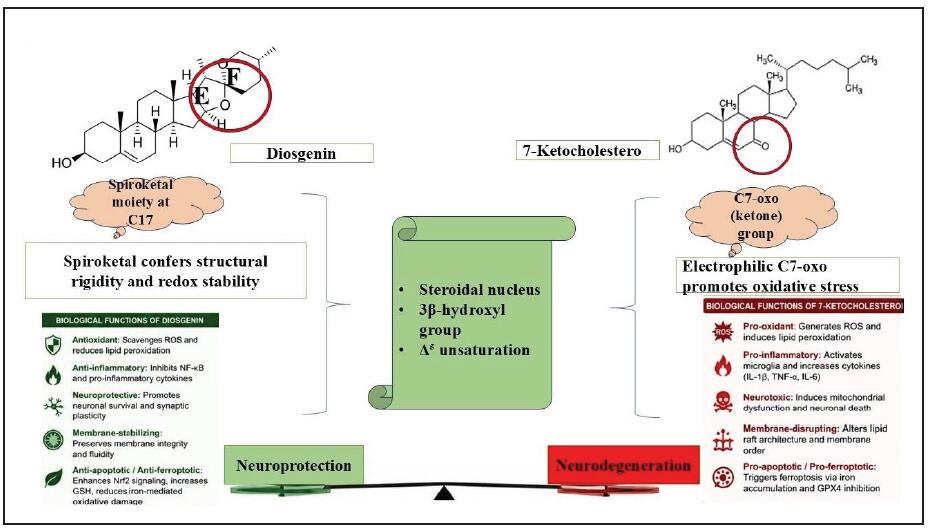
Figure 1. Structural and functional comparison of diosgenin and 7-KC. Both molecules share a common steroidal nucleus containing a 3β-hydroxyl group and Δ5 unsaturation. However, diosgenin contains a characteristic spiroketal moiety at C17 that confers structural rigidity, redox stability, and neuroprotective properties, whereas 7-KC possesses an electrophilic C7-oxo (ketone) group associated with oxidative stress, inflammation, ferroptosis, and neuronal injury. These structural differences underpin their opposing biological effects, with diosgenin exhibiting antioxidant, anti-inflammatory, membrane-stabilizing, and neuroprotective activities, while 7-KC promotes neurodegenerative processes. The balance between these contrasting mechanisms highlights diosgenin as a potential structural and functional antagonist of 7-KC-induced neurotoxicity in Alzheimer's disease.
Polypharmacological mechanisms in neuroprotection
Diosgenin has a multi-target neuroprotective profile that could be related to AD. Its lipophilicity and sterol-like structure may enable interactions with membrane environments, thereby preventing oxysterol-induced breakdown of lipid rafts. In addition, diosgenin has been shown to reduce oxidative stress, inflammation, and amyloid-associated damage in experimental animals by modulating metabolic nuclear receptor signaling and activating cytoprotective pathways such as autophagy and Nrf2-linked antioxidant responses [17, 33, 34]. Additionally, new research indicates that diosgenin’s antioxidant action, improvement of Nrf2 signaling, maintenance of mitochondrial function, and decrease of lipid peroxidation may reduce ferroptosis-associated pathways. These findings may further support diosgenin’s protective benefits against oxysterol-induced neurotoxicity, as 7-KC has been linked to ferroptotic neuronal death. In rat models with Aβ1-42, diosgenin dramatically enhances cognition, restoring spatial learning and memory in radial arm maze and passive avoidance tests. It protects hippocampal neurons, lessens oxidative stress and neuroinflammation, and lowers the burden of Aβ plaque. Mechanistically, diosgenin promotes neurogenesis and synaptic repair by stimulating nerve growth factor (NGF), activating PI3K/Akt signaling, inhibiting GSK3β, and upregulating brain-derived neurotrophic factor (BDNF) and cAMP response element-binding protein (CREB) phosphorylation. Diosgenin reduces acetylcholinesterase activity and rescues memory impairments in scopolamine and Aβ neurotoxicity models. These results show the multi-target neuroprotective effects of diosgenin against AD pathogenesis [35-37].
The semi-synthetic roadmap for blood–brain barrier (BBB) penetration
From a drug discovery perspective, structural-activity relationship and formulation techniques may be utilized to alleviate diosgenin’s inherent bioavailability constraints and enhance its translational potential for Alzheimer’s disease. A viable method to enhance aqueous solubility and adjust pharmacokinetic characteristics at the scaffold level is C3 derivatization with amino-containing groups or conjugates based on amino acids. While lipid-based nanocarriers or polymeric nanoparticles can further increase brain delivery and overall central nervous system (CNS) exposure, semi-synthetic modification of the steroidal core may be utilized to improve metabolic stability [35, 38-40]. The therapeutic implications are significant. By structurally resembling oxysterols while functionally avoiding their liabilities, diosgenin derivatives could competitively inhibit 7-KC binding at membrane microdomains or receptor sites, reducing its accumulation in vulnerable tissues. This strategy may hold value in conditions such as vascular dysfunction, age-related macular degeneration, and neurodegenerative disorders where oxysterol toxicity is implicated. From a drug discovery standpoint, diosgenin’s scaffold offers opportunities for semi-synthetic modification, allowing medicinal chemists to generate redox-stable analogues tailored toward selective receptor modulation, improved pharmacokinetics, or targeted delivery.
Conclusions
Diosgenin represents a promising multi-target neuroprotective scaffold for AD owing to its structural compatibility with sterol-rich neuronal membranes and its ability to counteract oxidative stress, neuroinflammation, amyloid toxicity, and synaptic dysfunction. Unlike the pro-oxidant oxysterol 7-KC, diosgenin exhibits redox-stable and neurorestorative properties that may attenuate multiple pathological hallmarks of AD. Future investigations focusing on BBB-targeted formulations, semi-syn-thetic optimization, and clinical translation may establish diosgenin as a novel phytotherapeutic candidate for AD intervention.
Declarations
Acknowledgement
Authors would like to thank their university for the technical support.
Author contributions
The author contributed solely to the article.
Availability of data and materials
Not applicable.
Conflicts of interest
The author declare that they have no known competing financial interests or personal relationships that could have appeared to influence the work reported in this paper.
Financial support and sponsorship
None.
Ethical approval and consent for publication
Not applicable.
AI and AI-assisted tools statement
During the preparation of this work, the authors used AI-powered language models to refine the manuscript’s grammar, syntax, flow, and overall readability. Additionally, AI-assisted graphic tools were employed to help generate, format, and optimize the figures and schematics presented in this study.
References
1. Heo D, Kim M, Lee Y, Kim S, Kim Y, Sung W, et al. Unravelling the interplay: brain regional atrophy and neuropsychological function in early Alzheimer’s disease. Front Aging Neurosci, 2025, 17: 1508849. [Crossref]
2. Rao Y, Ganaraja B, Murlimanju B, Joy T, Krishnamurthy A, & Agrawal A. Hippocampus and its involvement in Alzheimer’s disease: a review. 3 Biotech, 2022, 12(2): 55-68. [Crossref]
3. Guarino A, Favieri F, Boncompagni I, Agostini F, Cantone M, & Casagrande M. Executive functions in Alzheimer disease: a systematic review. Front Aging Neurosci, 2018, 10: 437-448. [Crossref]
4. Igarashi K. Entorhinal cortex dysfunction in Alzheimer’s disease. Trends Neurosci, 2023, 46(2): 124-136. [Crossref]
5. Alzheimer’s Association. 2025 Alzheimer’s disease facts and figures. Alzheimers Dement, 2025, 21(4): e70235. [Crossref]
6. Parameswari M, Deepa N, Sathya Priya J, & Muthulakshmi K. A computational framework for Alzheimer’s disease detection using SwinRes Transformer. Comput Biol Med, 2026, 208: 111663. [Crossref]
7. Kakkar A, Singh H, Jasoria Y, Kumar A, Chopra S, Chopra H, et al. Bridging pathologies: mechanistic insights into the diabetes-Alzheimer’s nexus. Excli J, 2026, 25: 261-289. [Crossref]
8. Kakkar A, Singh H, Singh B, Chauhan K, Chopra S, Chopra H, et al. Molecular mechanisms of aging in the pathogenesis of Alzheimer’s disease. Discov Neurosci, 2026, 21(1): 13-26. [Crossref]
9. Cummings J, Zhou Y, Yang Y, Zhong K, Fonseca J, Osse A, et al. Alzheimer’s disease drug development pipeline: 2026. Alzheimers Dement, 2026, 12(2): e70251. [Crossref]
10. Rossi M, Freschi M, de Camargo Nascente L, Salerno A, de Melo Viana Teixeira S, Nachon F, et al. Sustainable drug discovery of multi-target-directed ligands for Alzheimer’s disease. J Med Chem, 2021, 64(8): 4972-4990. [Crossref]
11. Wang S, Kong X, Chen Z, Wang G, Zhang J, & Wang J. Role of natural compounds and target enzymes in the treatment of Alzheimer’s disease. Molecules, 2022, 27(13): 4175-4189. [Crossref]
12. Mahalakshmi K, Parimalanandhini D, Sangeetha R, Livya Catherene M, Beulaja M, Thiagarajan R, et al. Influential role of 7-Ketocholesterol in the progression of Alzheimer’s disease. Prostaglandins Other Lipid Mediat, 2021, 156: 106582. [Crossref]
13. Dias I, Diaz-Sanchez L, Angelini T, & Marinozzi M. 7-keto cholesterol as a mediator in Alzheimer’s disease pathogenesis. Alzheimers Dement, 2025, 21(S2): e105279. [Crossref]
14. Natania S. Targeting 7-ketocholesterol–driven metabolic dysfunction in obesity: therapeutic potential of Bifidobacterium and dietary antioxidants. J Steroid Biochem Mol Biol, 2026, 260: 106998. [Crossref]
15. Sukumaran E, & Natania S. Why 7-ketocholesterol matters now: a rapid review of its pathogenic and therapeutic relevance. J Steroid Biochem Mol Biol, 2026, 255: 106865. [Crossref]
16. Weigel T, Kulas J, & Ferris H. Oxidized cholesterol species as signaling molecules in the brain: diabetes and Alzheimer’s disease. Neuronal Signal, 2019, 3(4): NS20190068. [Crossref]
17. Som S, Antony J, Dhanabal S, & Ponnusankar S. Neuroprotective role of diosgenin, a NGF stimulator, against Aβ (1–42) induced neurotoxicity in animal model of Alzheimer’s disease. Metab Brain Dis, 2022, 37(2): 359-372. [Crossref]
18. Manrique-Moreno M, Londoño-Londoño J, Jemioła-Rzemińska M, Strzałka K, Villena F, Avello M, et al. Structural effects of the Solanum steroids solasodine, diosgenin and solanine on human erythrocytes and molecular models of eukaryotic membranes. Biochim Biophys Acta Biomembr, 2014, 1838(1, Part B): 266-277. [Crossref]
19. Koh E, Yun W, Kim J, Song S, Sung J, Lee H, et al. Beneficial effect of diosgenin as a stimulator of NGF on the brain with neuronal damage induced by Aβ-42 accumulation and neurotoxicant injection. Lab Anim Res, 2016, 32(2): 105-115. [Crossref]
20. Semwal P, Painuli S, Abu-Izneid T, Rauf A, Sharma A, Daştan S, et al. Diosgenin: an updated pharmacological review and therapeutic perspectives. Oxid Med Cell Longev, 2022, 2022: 1035441. [Crossref]
21. Huang N, Yu D, Wu J, & Du X. Diosgenin: an important natural pharmaceutical active ingredient. Food Sci Technol, 2021, 42: e94521. [Crossref]
22. Yang X, & Tohda C. Diosgenin restores memory function via SPARC-driven axonal growth from the hippocampus to the PFC in Alzheimer’s disease model mice. Mol Psychiatry, 2023, 28(6): 2398-2411. [Crossref]
23. Sabarathinam S, & Ganamurali N. Targeting 7-ketocholesterol-induced oxidative stress and inflammation: guggulsterone as a novel vascular protectant. J Steroid Biochem Mol Biol, 2025, 254: 106846. [Crossref]
24. Sabarathinam S, & Ganamurali N. Guggulsterone as a dual-function steroidal scaffold: cholesterol modulation and bioenhancement potential against 7-ketocholesterol-Linked pathologies. J Steroid Biochem Mol Biol, 2025, 254: 106848. [Crossref]
25. Lombardino J, & Lowe J. The role of the medicinal chemist in drug discovery — then and now. Nat Rev Drug Discov, 2004, 3(10): 853-862. [Crossref]
26. Lehmann J, Kliewer S, Moore L, Smith-Oliver T, Oliver B, Su J, et al. Activation of the nuclear receptor LXR by oxysterols defines a new hormone response pathway. J Biol Chem, 1997, 272(6): 3137-3140. [Crossref]
27. S AN. Oxysterols as endogenous lipid toxins and toxic signaling mediators in chronic disease. Compr Physiol, 2026, 16(3): e70162. [Crossref]
28. Salunkhe R, Gadgoli C, Naik A, & Patil N. Pharmacokinetic profile and oral bioavailability of diosgenin, charantin, and hydroxychalcone from a polyherbal formulation. Front Pharmacol, 2021, 12: 629272. [Crossref]
29. Sun F, Yang X, Ma C, Zhang S, Yu L, Lu H, et al. The effects of diosgenin on hypolipidemia and its underlying mechanism: a review. Diabetes Metab Syndr Obes, 2021, 14: 4015-4030. [Crossref]
30. Son I, Kim J, Sohn H, Son K, Kim J, & Kwon C. Antioxidative and hypolipidemic effects of diosgenin, a steroidal saponin of yam (Dioscorea spp.), on high-cholesterol fed rats. Biosci Biotechnol Biochem, 2007, 71(12): 3063-3071. [Crossref]
31. Li R, Liu Y, Shi J, Yu Y, Lu H, Yu L, et al. Diosgenin regulates cholesterol metabolism in hypercholesterolemic rats by inhibiting NPC1L1 and enhancing ABCG5 and ABCG8. Biochim Biophys Acta Mol Cell Biol Lipids, 2019, 1864(8): 1124-1133. [Crossref]
32. Ondevilla J, Hanashima S, Mukogawa A, Umegawa Y, & Murata M. Diosgenin-induced physicochemical effects on phospholipid bilayers in comparison with cholesterol. Bioorg Med Chem Lett, 2021, 36: 127816. [Crossref]
33. Chen S, Sun S, Feng Y, Li X, Yin G, Liang P, et al. Diosgenin attenuates nonalcoholic hepatic steatosis through the hepatic FXR-SHP-SREBP1C/PPARα/CD36 pathway. Eur J Pharmacol, 2023, 952: 175808. [Crossref]
34. Feng J, Zhang W, Liu R, Xiang T, & Wu X. Dioscin regulates oxidative stress and autophagy in uric acid-induced HK-2 cells through the P62-KEAP1-NRF2 signaling pathway. BMC Nephrol, 2025, 26(1): 422-438. [Crossref]
35. Cai B, Zhang Y, Wang Z, Xu D, Jia Y, Guan Y, et al. Therapeutic potential of diosgenin and its major derivatives against neurological diseases: recent advances. Oxid Med Cell Longev, 2020, 2020(1): 3153082. [Crossref]
36. Chen X, Zhang M, Qian L, Guo Y, Zhu Y, Taxi W, et al. activates ERα-dependent PI3K/AKT/GSK3β signaling to enhance brain-derived serotonin and alleviate postmenopausal bone loss. J Adv Res, 2025, [Epub ahead of print]. [Crossref]
37. Biswas S, Patil P, Ranjan S, & Gautam A. Exploring the therapeutic potential of dioscin and diosgenin in neurological disorders. Brain Behav Immun Integr, 2024, 7: 100069. [Crossref]
38. Mehta M, Bui T, Yang X, Aksoy Y, Goldys E, & Deng W. Lipid-based nanoparticles for drug/gene delivery: an overview of the production techniques and difficulties encountered in their industrial development. ACS Materials Au, 2023, 3(6): 600-619. [Crossref]
39. Liu S, Jin X, Ge Y, Dong J, Liu X, Pei X, et al. Advances in brain-targeted delivery strategies and natural product-mediated enhancement of blood-brain barrier permeability. J Nanobiotechnology, 2025, 23(1): 382-396. [Crossref]
40. Patel P, Garala K, Singh S, Prajapati B, & Chittasupho C. Lipid-based nanoparticles in delivering bioactive compounds for improving therapeutic efficacy. Pharmaceuticals, 2024, 17(3): 329-340. [Crossref]